When your hours move every week, a budget built on last month’s number breaks the first time a short check lands. Budgeting on an irregular paycheck works when the plan runs on your lowest check and the extra gets banked to cover the next short one.
Budgeting on an irregular paycheck: why the average lies
You’re not the only one doing this math. In the Federal Reserve’s latest survey of household finances, 30% of adults said their income varied at least occasionally in 2025, and 11% said they struggled to pay bills in the past year because of it. Among people who work for someone else, 28% reported income that moved around. Variable schedules aren’t a gig-worker problem. They’re a support-job, retail, healthcare, and hourly-anything problem.
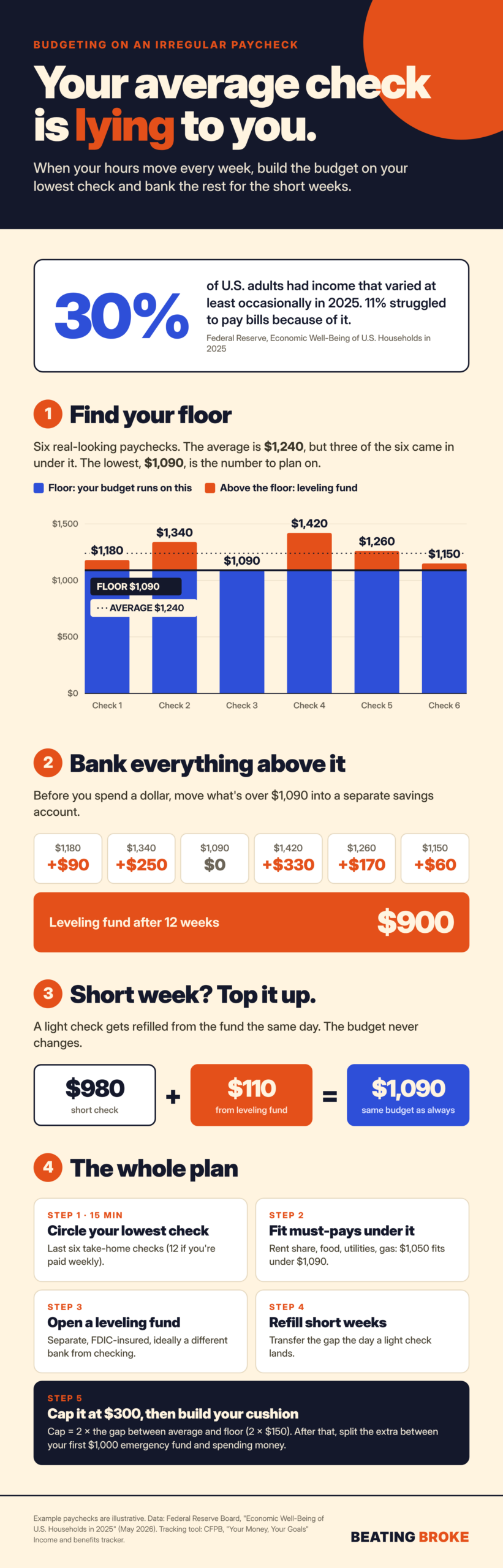
Take six paychecks (every two weeks, after taxes) from someone on a variable schedule:
- $1,180
- $1,340
- $1,090
- $1,420
- $1,260
- $1,150
Add them up and you get $7,440. Divide by six and the average is $1,240. That’s the number a standard budget template would have you plan on.
The problem: three of those six checks came in under $1,240. If your rent share, groceries, and gas are planned against the average, half your paydays start in the hole. That’s how a “working” budget ends in an overdraft on a Tuesday.
The floor in that list is $1,090. That’s the number to build on.
Step 1: Find your floor (15 minutes, tonight)
Open your bank app and write down your last six take-home paychecks. If you’re paid weekly, use the last 12. Circle the lowest one. That’s your floor.
If one check was unusually low for a reason that won’t repeat (a week you were out sick, say), you can drop it and use the next-lowest. Be honest with yourself here. December often brings a short week for holiday closures, so if last December’s checks were low, count one of them.
The CFPB’s free Income and benefits tracker lays this out week by week and asks you to sort income into regular, irregular, seasonal, and one-time, so you can see “what income you can count on each month.” A spreadsheet with one column per paycheck does the same job.
Step 2: Fit the must-pays inside the floor
List what has to be paid every two weeks to keep the lights on and the car running. Using the example above, with rent of $1,300 a month:
- Rent (half of $1,300): $650
- Groceries: $180
- Utilities and phone (half the monthly total): $100
- Gas and car insurance: $120
That’s $1,050 per paycheck, which fits under the $1,090 floor with $40 to spare.
If your must-pays come in above your floor, that’s the most useful thing this exercise can tell you. It means the budget was never going to work on a short week, and it isn’t a willpower problem. Look first at the bills with due dates you can move. The CFPB’s budgeting guide points out that if you’re coming up short, “the timing for your bills and income don’t match.” Some utilities and card issuers will move a due date if you call and ask, so the big bill lands on the payday that can carry it. It costs one phone call to find out.
Step 3: Open a separate leveling fund
Every dollar above your floor goes into a separate savings account before you spend any of it. Call it your leveling fund. Its only job is to top up the short checks.
With the six checks above, the fund fills like this:
- $1,180 check: $90 over the floor, into the fund
- $1,340 check: $250 into the fund
- $1,090 check: $0 (this is the floor)
- $1,420 check: $330 into the fund
- $1,260 check: $170 into the fund
- $1,150 check: $60 into the fund
That’s $900 over 12 weeks that used to get spent without a plan because it felt like extra. It wasn’t extra. It was next month’s short week, showing up early.
Keep the fund at a different bank or credit union from your checking if you can, so it doesn’t show up in your spending balance. Check that the bank is FDIC-insured; the FDIC covers $250,000 per depositor, per insured bank, for each ownership category, which is far more than this fund will ever hold.
Step 4: Pay yourself back from the fund on short weeks
When a check comes in under your floor (a $980 week, say), move $110 from the leveling fund into checking that same day, so you’re spending from $1,090 like always. The budget doesn’t change. Only the source of the money does.
This is what kills the overdraft cycle. A short week used to mean a declined card or an overdraft fee. Now it’s a transfer. If overdrafts have already been eating your checks, this piece on stopping overdraft fees covers the one call that makes a short week cost a decline instead of a fee.
Step 5: Set a cap, then send the rest to your cushion
The leveling fund doesn’t need to grow forever. A good cap is two times the gap between your average and your floor. In the example, that’s $1,240 minus $1,090, or $150, times two: $300.
Once the fund holds $300, anything above the floor gets split. Put part toward your first $1,000 emergency fund and keep part as spending money for the week. That cushion matters: the Fed’s survey found that 63% of adults would cover a surprise $400 expense with cash or its equivalent, which leaves 37% who would have to borrow, sell something, or couldn’t cover it. The leveling fund handles short paychecks. The cushion handles the car battery.
The catch
This plan feels tight at first. Building on your lowest check means the good weeks don’t feel good, because the extra goes into savings instead of dinner out. Give it two months. The first short week you cover without panic is when it starts to make sense.
It also won’t fix a budget where the must-pays sit above every check you get. If your floor is $900 and the bills are $1,050, the leveling fund will drain in a few weeks. That’s a sign the math needs more income or a cheaper fixed bill, not more discipline.
And if your income swings because you’re self-employed or doing gig work, the floor method still works, but you also need to set money aside for taxes before you figure out the floor. The Fed found 58% of self-employed adults had income that varied month to month, so you’re far from alone there either.
What to do this week
Tonight, pull your last six take-home paychecks and circle the lowest one. On your next payday, move everything above that number into a separate savings account before you buy anything. Even if it’s $40, that’s $40 already waiting for your next short week.
Sources
- Board of Governors of the Federal Reserve System, “Economic Well-Being of U.S. Households in 2025: Income and Expenses”, May 2026 (accessed November 13, 2026)
- Board of Governors of the Federal Reserve System, “Economic Well-Being of U.S. Households in 2025: Savings and Investments”, May 2026 (accessed November 13, 2026)
- Consumer Financial Protection Bureau, “Your Money, Your Goals: Income and benefits tracker” (accessed November 13, 2026)
- Consumer Financial Protection Bureau, “Budgeting: How to create a budget and stick with it”, June 5, 2019 (accessed November 13, 2026)
- Federal Deposit Insurance Corporation, “Understanding Deposit Insurance”, April 1, 2024 (accessed November 13, 2026)