If you’re carrying balances on three cards and can’t decide which one gets the extra $100, you have company: Americans now owe a record $1.29 trillion on credit cards, according to the New York Fed’s Q3 2026 Household Debt and Credit Report. The debt snowball vs. avalanche question usually gets argued like a personality quiz, so we ran both on a realistic set of cards to show you the actual dollar gap and let you pick a method before your next payday.
What each method does
Both methods start the same way. You pay the minimum on every card, every month, no exceptions. The difference is where the extra money goes.
- Snowball: the extra goes to the smallest balance first. When that card hits $0, its whole payment rolls onto the next-smallest.
- Avalanche: the extra goes to the highest APR (what the card actually costs you per year) first, then rolls to the next-highest.
The CFPB’s guide to reducing debt describes the tradeoff plainly: the highest-rate method “can save you money in the long run,” while with the snowball “you’ll see progress quickly.” Both are true. The useful question is how much money, and how much quicker.
The three cards we ran
| Card | Balance | APR | Minimum |
|---|---|---|---|
| Store card | $500 | 30% | $25 |
| Card B | $1,500 | 20% | $40 |
| Card C | $3,500 | 27% | $90 |
| Total | $5,500 | $155 |
Those APRs aren’t scare numbers. The Federal Reserve’s G.19 Consumer Credit release put the average rate on credit card accounts that were charged interest at 22.36% in Q3 2026. Store cards often run higher.
Walk Card C’s first month. $3,500 times 27% is $945 in interest over a year. Divide by 12 and that’s $78.75 a month. So of the $90 minimum, $78.75 goes to interest and $11.25 actually lowers the balance.
Same math on the other two: Card B costs $25 a month in interest ($1,500 × 20% ÷ 12), and the store card costs $12.50 ($500 × 30% ÷ 12). That’s $116.25 of your $155 going to interest in month one.
Minimums only: 94 months
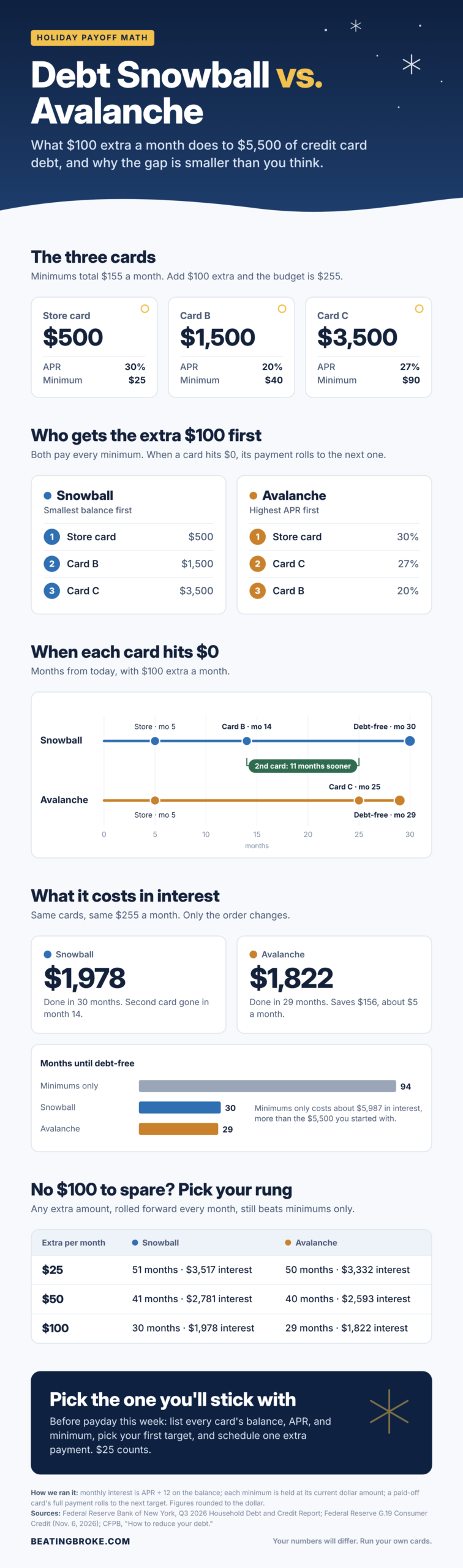
Pay exactly $155 a month, never roll a paid-off card’s payment forward, and the last card clears in month 94. That’s almost eight years, and about $5,987 in interest. More than the $5,500 you started with.
(We held each minimum at its current dollar amount. On real cards the minimum usually shrinks as the balance shrinks, which makes the minimums-only path longer, not shorter.)
Snowball vs. avalanche with $100 extra a month
Now the budget is $255 a month: $155 in minimums plus $100 extra. Every time a card hits $0, its payment rolls into the next target.
Snowball order: store card, Card B, Card C. Avalanche order: store card (it’s both the smallest balance and the highest APR), then Card C at 27%, then Card B at 20%.
| Snowball | Avalanche | |
|---|---|---|
| First card paid off | Month 5 | Month 5 |
| Second card paid off | Month 14 (Card B) | Month 25 (Card C) |
| Debt-free | Month 30 | Month 29 |
| Total interest | $1,978 | $1,822 |
Avalanche wins by $156 and one month. Spread over two and a half years, that’s about $5 a month.
Snowball wins on something a spreadsheet can’t price: your second card is gone in month 14 instead of month 25. That’s 11 months sooner with one less bill, one less due date, and one less statement to open.
And either method beats minimums only by about $4,000 in interest ($5,987 minus $1,978) and more than five years.
No $100 to spare? The ladder still works
| Extra per month | Snowball | Avalanche |
|---|---|---|
| $25 | 51 months, $3,517 interest | 50 months, $3,332 interest |
| $50 | 41 months, $2,781 interest | 40 months, $2,593 interest |
| $100 | 30 months, $1,978 interest | 29 months, $1,822 interest |
Even $25 a month extra, rolled forward, cuts the timeline from 94 months to about 50 and saves roughly $2,500 in interest. Pick the rung you can hold every month, not the one that looks best.
How to pick yours
- Pick avalanche if a debt-free date two years out is enough to keep you going. The bigger the APR gap between your cards, the more the avalanche saves.
- Pick snowball if you’ve started a payoff plan before and stalled around month six. A card hitting $0 is fuel, and $156 over 30 months isn’t worth a plan you’ll quit.
- If your smallest balance is also your highest APR (like the store card here), both methods agree on step one. Start there this payday and decide the rest later.
Set it up in five steps
- List every card tonight. Balance, APR, and minimum for each. The APR is on your statement in the interest charges section. Ten minutes.
- Find your extra. $25, $50, or $100 a month. Use the ladder above to see what each rung buys you.
- Put every minimum on autopay. One missed payment can mean a late fee, and on many cards a higher penalty rate, which wipes out the savings you’re working for.
- Send the extra as a separate payment on payday to your target card. Money that sits in checking until the due date tends to find another job.
- When a card hits $0, roll its full payment (its old minimum plus your extra) onto the next target. Don’t let it drift back into the grocery line.
The catch
Neither method works if new charges keep landing on the cards. If you have nothing set aside, one $400 car repair goes on a card and undoes four months of progress. If your cushion is under $500, split your extra between the cushion and the cards until it’s there.
This math also assumes your APRs stay put. If you can get one lowered, every number above improves; our piece on how to ask for a lower credit card APR has the script.
And if you can’t cover the minimums at all right now, a payoff method isn’t the next step. Call each card issuer and ask whether they have a hardship program before anything else.
What to do this week
Before your next payday, write down the balance, APR, and minimum for every card, pick your first target, and schedule one extra payment to it for payday. $25 counts. That’s the snowball or the avalanche started, whichever one you’ll actually stick with.
Sources
- Federal Reserve Bank of New York, “Household Debt Increased Moderately; Delinquency Transition Rates Remain Flat” (Q3 2026 Household Debt and Credit Report), November 10, 2026 (accessed November 12, 2026)
- Board of Governors of the Federal Reserve System, “G.19 Consumer Credit”, November 6, 2026 (accessed November 12, 2026)
- Consumer Financial Protection Bureau, “How to reduce your debt”, archived guidance, page last modified June 25, 2026 (accessed November 12, 2026)