Beating Broke

Personal Finance from the Broke Perspective

  • Home
  • About
  • We Recommend
  • Contact
  • Our Editorial Commitment

Powered by Genesis

The Benefits of Weekly Menu Planning

May 27, 2011 By MelissaB 3 Comments

Does this sound familiar?  It is 5 p.m., and you stop by the grocery store after work.  You don’t have much time to make dinner before you have to go to a parent/teacher conference at 7 p.m., so you buy some carrot sticks, a pound of meat, whole wheat buns and sloppy joe mix from a package.  Oh, don’t forget a bag of chips.  That covers dinner for tonight.

The next night, it is the same story, but this time you have had a really stressful day at work and all you want to do is go home and relax, so you go through the drive through and spend $25 to feed your family of four.

If this sounds familiar and you want to save yourself some time and money, try menu planning.

Life is busy whether you are a stay at home parent or employed full time, whether you have kids or not.  A menu plan is the best way to help control the chaos that surrounds dinner time.

The Time Investment
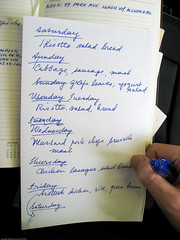
SML <3 Foodies! / 20090916.SD850IS.2859 / SMLTrue, it does take some time to create a menu plan, but you will reap the rewards all week long.  In the beginning, you can expect to spend about 30 to 60 minutes once a week picking your recipes and making a grocery list.  (The time you spend doing this will lessen as you become more comfortable with the routine and create a repertoire of recipes that you and your family like.)

The Time Payoff

If you go to the grocery store with a list of all the necessary ingredients needed to make your meals for the week, you will be focused.  You should be out of the grocery store in 60 minutes or less.

If you operate without a menu plan, it is not unusual to stop by the grocery store (or to go through the drive thru) four to five times a week.  If your average stop is about 20 to 30 minutes, you are spending 80 to 150 minutes a week.  Having a grocery list and shopping only once a week will save you 20 to 90 minutes a week!

The Financial Payoff

Unless you are extremely disciplined, you make impulse buys when grocery shopping.  Let’s say you make three impulse buys each time you shop.  If you only enter the grocery store once a week, you are only making 3 impulse buys.  If you grocery shop 5 times a week, you will likely make 15 impulse buys.  Depending on the price of the unplanned items, you could be spending as much as $15 to $30 and upwards a month by shopping so frequently.

If you make a menu plan and a grocery list, you give yourself time to look through the ads and choose recipes that take advantage of sale items, lowering your grocery bill overall.  By contrast, if you stop by the store every night and buy what you “feel” like eating that night or what is convenient to make, you will be spending much more weekly.

Even though it may not be something you do now, hopefully realizing the time and financial payoffs will have you thinking about menu planning.  Next time we will explore the mechanics of menu planning.

(B.B. Note: Make sure you come back on Tuesday to read about how to implement a Menu Plan!)

photo credit: See-ming Lee 李思明 SML

MelissaB
MelissaB

Melissa is a writer and virtual assistant. She earned her Master’s from Southern Illinois University, and her Bachelor’s in English from the University of Michigan. When she’s not working, you can find her homeschooling her kids, reading a good book, or cooking. She resides in New York, where she loves the natural beauty of the area.

www.momsplans.com/

Filed Under: budget, Frugality, Home, Saving, ShareMe Tagged With: frugal, frugaler, Frugality, grocery, menu plan, menu planning, Saving

Four Strategies To Get Dinner on the Table If You Are Single

May 9, 2011 By MelissaB 12 Comments

When I was a graduate student, I rarely cooked for myself.  I lived alone, and while I don’t mind leftovers, if I cooked a meal, I would have 4 to 6 servings for leftovers, and I would bore of them before I finished them.  Likewise, my mom currently lives alone, and she almost never cooks.  She always says, “What is the point of cooking for just one person?”  Instead, she goes out to eat frequently and splits a meal with her dining companion to save money.

If you live alone, you might also dislike cooking for one.  However, there are strategies you can implement to still be able to eat delicious, cost-effective meals at home, avoiding the need to rely on frozen dinners from the supermarket or restaurant food.

Pay a Friend to Cook for You.  You may have a friend who cooks for his/her family on a daily basis.  Why not ask if they would be willing to let you “buy” a serving of the meal?  I cook for my family nearly every night to keep our food costs down, and if I had a single friend, I would be more than willing to make an extra portion for her.  She could pay me $2 a meal, costing her $10 a week for 5 meals.  She would benefit because she would avoid the hassle of shopping and cooking, but she would still get a tasty home cooked meal, and I would benefit because I would just make a bit more of the meal than I was already planning to make and I would earn $40 a month for my effort (less the small cost of additional food for her portion).

Swap with Friends.  Arrange to swap meals with friends, either at work, at the gym, at your apartment complex, etc.  Get together a group of 5 friends; each night one of the five friends cooks the meal and each person gets a serving.  The only cost to you would be one evening of cooking and the groceries needed to make that meal.

Freezer Cook.   Once a month, take a day to make freezer friendly meals such as lasagna, soups, etc.  Make four meals from recipes that produce 4 to 6 servings.  You now have 16 to 24 dinners at your disposal.  Just pull them from the freezer and reheat.  If you want to increase the variety, the first month, don’t eat all of the freezer meals.  The next month, try 4 new recipes.  If you saved at least one serving from each meal you made the previous month, you now have 8 meals in your freezer rotation to choose from.  Most freezer meals are good for 3 to 6 months, so you could have quite a bit of variety by the third month.

Cook for Two.  Invest in a magazine like Cooking for Two and make meals from there.  Now, you have one serving for your meal, and one serving waiting for another meal.  Obviously, this method is a bit more time intensive than the other methods mentioned, but if you like to cook but don’t like all of the leftovers, this may be the way to go.

Even if you live alone and don’t like to cook because you get bored with the leftovers, you don’t have to rely on take out and restaurant food.  You can save a bundle by relying on one of these methods.

What are your favorite strategies when cooking for one?  Have you ever implemented any of the strategies mentioned above?

(B.B. note: Those are some terrific ideas, Melissa! As a guy, most of those ideas probably wouldn’t have ever occurred to me when I was in college.  Mostly because, as a guy, I hardly ever cooked. I know, blame me for the stereotype.  The group of guys that I hung out with, however, did do quite a bit of grilling at each others houses when we could.  When I grill now, it counts as cooking.  What we did back then?  Not nearly as much.  More of a “throw it on until it looks ready” sort of deal.)

MelissaB
MelissaB

Melissa is a writer and virtual assistant. She earned her Master’s from Southern Illinois University, and her Bachelor’s in English from the University of Michigan. When she’s not working, you can find her homeschooling her kids, reading a good book, or cooking. She resides in New York, where she loves the natural beauty of the area.

www.momsplans.com/

Filed Under: Frugality, Home, ShareMe Tagged With: cooking, frugal, Home, meals

Couples; To Combine Finances or Not?

April 29, 2011 By Shane Ede 12 Comments

Life
Married couples have been doing it for centuries.  Combining their finances is just something they’ve always done.  Call it tradition if you want.  Call it necessity.  Recently, it’s a tradition that has come under fire as being old and outdated.  After all, the reason that the tradition exists is because it was rather usual for the woman in the marriage to stay home and be a homemaker while the husband went off to work and earned the money.  Since the woman wasn’t contributing to the financial inflow, there was no reason for her to have her own account.  What would she put in it?

But, with a new age, comes new standards.  Now, it’s expected that a woman will enter the workforce (or, at least, the contingent workforce).  And she’ll remain there even after marriage.  Not only will she remain in the workforce, but there is a chance that she’ll bring more to the table financially than her husband.  Suddenly, the decision to combine finances isn’t such an easy one.  In fact, combining finances can lead to more arguments than keeping them separated, unless both parties are on the same page financially.  The way I see it, there are three ways you can handle finances as a couple.

Combined accounts. (What we do.)

We came to the conclusion early on in our marriage that combining finances made the most sense for us.  Neither of us made much more than the other, and we both brought about an equal amount of debt to the marriage.  We combined and pay all of our bills and other expenses from one account.  It makes it easier to balance, easier to pay, and avoids having to figure out how much each owes to what bill, or when/how to transfer money from one account to the bill pay account.

Combined account hybrid.

If you want the convenience of combined accounts, but still have a bit of an issue with purchasing things for each other.  Or, just want a “me” account where you can purchase whatever you want, whenever, no questions asked, a combined hybrid set up might make the most sense.  Combine all of your accounts, but open a new account in each of your names.  Those accounts get a set (budgeted) amount deposited into them each month.  Each account is completely hands off to the other partner.  Spend it however you like, as long as the cash is in the account to cover what you spend.

Completely separate.

You don’t like the idea of combined accounts at all.  They should be separate.  Each of you keeps your own account and you either agree on who is paying which bill, or you create a third account that each of you deposits your share of the bills into and pay all bills from that account.

Which is right for you? I can’t say which is right, or which is wrong for you.  It’s something that you need to sit down and discuss with your spouse/partner and decide on.  I think that combined finances are easier, but with automated deposits and bill pay, the separate accounts could be made pretty easy as well.  And, just because you settle on one way, doesn’t mean you can’t change it down the road.  What I will say is that people are sometimes quick to judge based on the decision that you make.  Are you too trusting by combining?  Not trusting enough by leaving things separate?  Perhaps your relationship is doomed if you don’t combine?

The truth of it is this: a majority of divorces have some root in money issues.  Forcing yourselves into a money model that you don’t like won’t help with that statistic.  Be open with each other about money.  Be willing to discuss your finances, both separately and combined, and get yourselves on a path to a solid financial future.  If you do that, it won’t matter which option you choose, it’ll be the right one.

photo credit: Will Folsom

Shane Ede

Shane Ede is a business teacher and personal finance blogger.  He holds dual Bachelors degrees in education and computer sciences, as well as a Masters Degree in educational technology.  Shane is passionate about personal finance, literacy and helping others master their money.  When he isn’t enjoying live music, Shane likes spending time with family, barbeque and meteorology.

beatingbroke.com

Filed Under: General Finance, Home, Married Money, ShareMe Tagged With: budget, budgeting, combined finances, couple money, marriage, married money, separate finances

  • « Previous Page
  • 1
  • …
  • 29
  • 30
  • 31
  • 32
  • 33
  • …
  • 37
  • Next Page »

Improve Your Credit Score

Money Blogs

  • Budget and the Bees
  • Celebrating Financial Freedom
  • Christian PF
  • Clever Dude
  • Dual Income No Kids
  • Everybody Loves Your Money
  • Financial Panther
  • Gajizmo.com
  • Grocery Coupon Guide
  • Lazy Man and Money
  • Make Money Your Way
  • Money Talks News
  • Personal Profitability
  • PF Blogs
  • Reach Financial Independence
  • Saving Advice
  • The Savvy Scot
  • Yes, I am Cheap

Categories

Disclaimer

Please note that Beating Broke has financial relationships with some of the merchants mentioned here. Beating Broke may be compensated if consumers choose to utilize the links located throughout the content on this site and generate sales for the said merchant.

Visit Our Advertisers

Need to change careers? Consider an Accounting Certificate Program from WTI.
  • Home
  • About
  • We Recommend
  • Contact
  • Our Editorial Commitment

Subscribe to our newsletter

Please enable JavaScript in your browser to complete this form.
Loading


Beating Broke Personal Finance from the Broke Perspective

All content on Beating Broke is for entertainment purposes only. By reading this blog, you agree that Beating Broke is not responsible for any actions taken after reading this blog. For the full disclaimer.

Financial Disclaimer

Please note that Beating Broke has financial relationships with some of the merchants mentioned here. Beating Broke is funded by banner advertising, commission sales and search optimization consulting.

Copyright © 2006-2026 Novara Unlimited LLC | All Rights Reserved. |
Privacy Policy | Terms of Service
Beating Broke is operated by Novara Unlimited LLC