Beating Broke

Personal Finance from the Broke Perspective

  • Home
  • About
  • We Recommend
  • Contact
  • Our Editorial Commitment

Powered by Genesis

Affluent Wants vs. Needs

November 8, 2010 By Shane Ede 4 Comments

We already know that a good portion of saving money (both saving in savings accounts and saving on spending) can be determining whether something that we think we need is really a need or not and whether we could really do without that need. The underlying problem there is that as we become more affluent, wants become needs. This isn’t a new problem.

What those wants are has changed, but the problem remains.  In the days of the Roman empire, things like Oranges were considered a luxury.  They didn’t have the ability to transport them as quickly as we can now.  Because they were unable to get them somewhere quickly, they would spoil in all but a few cases.  The elites of the time were affluent enough that they could afford to dedicate a whole team of chariots and riders to move the Oranges from the orchard to their homes as quickly as was possible in the times.  Today, oranges are a bit more commonplace.  And, as such, aren’t nearly the luxury that they were to ancient civilizations.  The same is true for many different commodities.

Without money

And so, we can be said to be equivalent of a Roman elitist.  But, even as we are equal in many ways when we compare our access to certain things, we are not equal in socio-economic standing.  We aren’t elitists.  We’re the modern day equivalent, in that way, of your average, everyday Roman.  Just as the elite Romans had their scarce commodities, the elites of our society have theirs.  Bentleys, Mansions, Lear Jets, and Caviar just to name a few.

One of the hazards of harnessing our personal finances is that we may begin to loosen our own self-made restrictions and some of our wants might become needs.  Sure, a private jet would be nice.  I want a private jet.  I certainly don’t need one, though.  But, what if my prowess with personal finance (stop laughing) causes me to become more wealthy than I could possibly imagine.  As it becomes easier and easier for me to get that jet without breaking the bank, it also becomes easier and easier for that want to morph into a need.

A jet is a bit of an extreme example.  But, apply the same concept to one of the things that you want now.  Here’s a perfect example from my own financial adventures.  About 7 years ago, shortly after my wife and I became engaged, we decided that we needed to move from the apartment we were in and into something that was a little bit more pet friendly.  If you’ve ever tried to have a 100+ pound dog in a one bedroom apartment, you know what I’m talking about.  Initially, we were talking about finding a house to rent that allowed pets.  However, the more we looked at it, the more we discussed buying a house.  We wanted to buy a house.  But, as we looked at houses to rent, we convinced ourselves that we needed a house.  And we bought one.  Now, 7-ish years later, we want to move into a bigger house to make room for our two children and a dog.  We certainly don’t need a bigger house.  But we want one.  As we get a better handle on our finances, it’s very possible that what we want now will become a need if we let it.

I won’t say whether that will be a bad thing or not.  Some would argue that if we don’t truly need the bigger house, we shouldn’t buy it.  Others will say that if we have saved up and can afford it, we should go for it.  That’s not the point of this article though.  What is the point?

Awareness.  One of the most important factors in your personal finance journey will be how aware you are of your situation.  Being aware enough to understand what you can and cannot afford as well as what is and isn’t a need will be a determining factor in where your finances end up when you are ready to retire.  Moreover, being oblivious to your situation isn’t an excuse.  Be responsible for your situation.  Learn how to fix your mistakes.  And become aware of your situation so that you can make educated choices for your financial welfare.

Image Credit: Without money by Toban Black, on Flickr

Shane Ede

Shane Ede is a business teacher and personal finance blogger.  He holds dual Bachelors degrees in education and computer sciences, as well as a Masters Degree in educational technology.  Shane is passionate about personal finance, literacy and helping others master their money.  When he isn’t enjoying live music, Shane likes spending time with family, barbeque and meteorology.
www.beatingbroke.com

Filed Under: budget, Consumerism, Debt Reduction, Frugality, Personal Finance Education, Retirement, Saving, ShareMe Tagged With: affluent, elite, financial awareness, needs, oranges, roman, wants

Even a Little Movement is Better Than None

October 11, 2010 By Shane Ede 7 Comments

Consider this image the inspiration for this post.  It’s one of many daily photos and videos that the folks over at failblog.org post to their site.  If your curious, the fail here is that she’s sitting on a chair over the treadmill.  And at the core, they are right.  Just sitting there, she won’t get any exercise.  If she moves her legs as if she were walking on the treadmill, she might get some, but still very little.  Not nearly as much as she would if she were standing and walking the treadmill.  Or, better yet, if she were running on the treadmill.

But, sometimes, we get too stuck on doing something 100% or not doing it at all.  Instead we should realize that we sometimes have to start at 50% and work our way up.

Don’t get me wrong.  I’m all for giving something your all.  But, if giving something all your resources does more harm than good, you’ve got to know how to scale.  Take this lady in the picture.  She looks a bit on the overweight side.  Likely has problems with her knees.  Likely, she can’t walk long enough on the treadmill to do any good.  So, she sits on a chair and “walks” on the treadmill with just the lower legs.  Eventually, if she sticks to a diet and keeps doing exercise, she might lose enough weight to alleviate the pain in her knees and she can begin to walk on the treadmill.  But, if she were to try and do only that now, she might damage her knees further, or frustrate herself so much with the pain that she quits trying and resigns herself to a scooter chair the rest of her life.

The same thing applies in personal finance.  Each and every one of us would love to pay off all of our debt.  Even better would be to pay it all off all at once.  But we don’t.  Why not?  Wouldn’t that be “giving 100%”?  Sure, but we all have bills.  And most of us like to eat something now and again.  Instead, we give 20% or 30%, or whatever we can afford after we’ve paid our bills and eaten.  We take that little bit and pay it towards our bills.  Eventually, as those bills shrink, we can pay more towards them.  And if we keep on that track, we will eventually pay off all of our debt.  Just like the woman, we find ourselves running on the “debt free treadmill“.

Want to invest?  You’ve gotten good returns on what you’ve already invested.  Why not just sign over your paycheck to your broker and build your portfolio?  The returns are better there than they are in the electric companies bank.  Again, we still have bills and necessities to buy.  We can’t give all 100% of our income to one purpose.  We have to budget, and learn how to be satisfied with giving what we can, even if it isn’t 100%.

Life isn’t a “110%” game.  It’s about striking a balance where the different parts of your life all flourish with what you’ve given them.  Don’t fall into the trap of thinking that you’re not doing it well, or that you’re failing just because you aren’t putting 100% towards it.  Sometimes, even a little movement is better than none.

Image credit: failblog.org

Shane Ede

Shane Ede is a business teacher and personal finance blogger.  He holds dual Bachelors degrees in education and computer sciences, as well as a Masters Degree in educational technology.  Shane is passionate about personal finance, literacy and helping others master their money.  When he isn’t enjoying live music, Shane likes spending time with family, barbeque and meteorology.

www.beatingbroke.com

Filed Under: budget, Debt Reduction, General Finance, ShareMe Tagged With: give 100%, inspiration, Personal Finance, personal finance inspiration

The Debt Free Treadmill

October 8, 2010 By Shane Ede 6 Comments

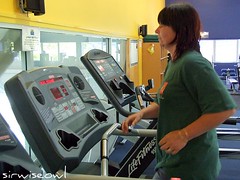
Treadmill  WorkoutWhen you’ve got bills and debt to pay off, you are constantly feeling like you’re running a personal finance marathon.  Each month is a sprint to the finish to see how much debt you can pay off.  We do it to get to that finish line.  To send that last check (or bill pay payment) and then run into the streets screaming.  Some of us may even follow that up with a call to a certain Mr. Ramsey.  With any luck, most of us will reach that point sooner rather than later.

But, then what?  We’re done paying off debt.  We don’t need this silly budget thing anymore right?  And we certainly don’t need to be worried about how much we’re spending.  And so what if we leave a balance on our credit cards now and again.  Wrong.  Oh so wrong.  If your years of debt repayment hasn’t conditioned you to it already, you’ll soon find out that you still have to do all of that.  You might be able to loosen the strings a little, but keeping those habits is what will keep you from ever going back there again.

Just like any physical trainer will tell you; if you want to keep in marathon shape, you’ve got to keep maintaining your fitness. You can’t expect to stop and then still be able to run another marathon. In short, you’ve got to keep on the treadmill.

With all of your debt paid off and only your monthly expenses to worry about, you’ve got to get on “the Debt Free Treadmill”. You’ve got to use it to keep your self in financial shape. However, in this case, it is so you never have to run that marathon again. Debt is an easy trap to fall into. It only takes one lazy month to leave a little balance on a credit card and start the cycle all over.

Get on “the Debt Free Treadmill”!  Keep yourself in financial shape by continuing the same habits of saving, budgeting, investing, and frugality that you used to finish that marathon.  Use it to your advantage.  Unlike a large majority of the people in this world, you aren’t running that marathon.  Best of all, you get to use that financial fitness to benefit others.  Share your knowledge, and help people reach the marathon finish line so that they can jump on “the Debt Free Treadmill”!

Image Credit: Treadmill Workout by sirwiseowl, on Flickr

Shane Ede

Shane Ede is a business teacher and personal finance blogger.  He holds dual Bachelors degrees in education and computer sciences, as well as a Masters Degree in educational technology.  Shane is passionate about personal finance, literacy and helping others master their money.  When he isn’t enjoying live music, Shane likes spending time with family, barbeque and meteorology.

www.beatingbroke.com

Filed Under: budget, Debt Reduction, Frugality, Investing, Saving, ShareMe Tagged With: budget, debt treadmill, financial fitness, financial marathon, Frugality, Investing, Saving, treadmill

  • « Previous Page
  • 1
  • …
  • 50
  • 51
  • 52
  • 53
  • 54
  • …
  • 57
  • Next Page »
  • Facebook
  • Pinterest
  • RSS
  • Twitter

Improve Your Credit Score

Money Blogs

  • Budget and the Bees
  • Celebrating Financial Freedom
  • Christian PF
  • Clever Dude
  • Dual Income No Kids
  • Everybody Loves Your Money
  • Financial Panther
  • Gajizmo.com
  • Grocery Coupon Guide
  • Lazy Man and Money
  • Make Money Your Way
  • Money Talks News
  • Personal Profitability
  • PF Blogs
  • Reach Financial Independence
  • Saving Advice
  • The Savvy Scot
  • Yes, I am Cheap

Categories

Disclaimer

Please note that Beating Broke has financial relationships with some of the merchants mentioned here. Beating Broke may be compensated if consumers choose to utilize the links located throughout the content on this site and generate sales for the said merchant.

Visit Our Advertisers

Need to change careers? Consider an Accounting Certificate Program from WTI.
  • Home
  • About
  • We Recommend
  • Contact
  • Our Editorial Commitment